Turn a Repeated Trail Mistake Into One Practice Goal
I’ll clarify how to turn recurring dabs, missed corners, and braking mistakes into one precise practice goal, so your next trail session produces useful feedback instead of another round of vague frustration.
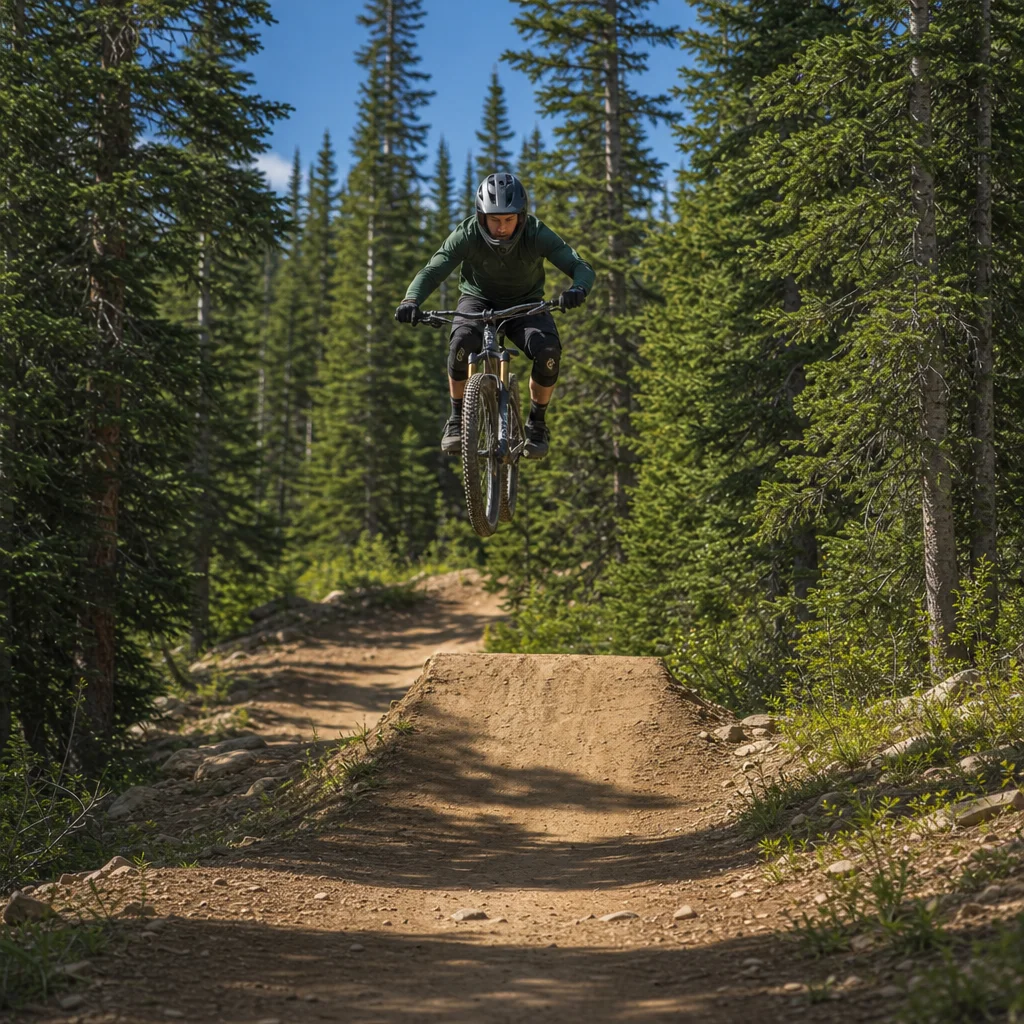
Repeatedly making the same mistake on a trail is useful information, but it rarely tells you exactly what to practise. “I need to ride corners better” is too broad to guide your next session, while “brake less” might make the original problem worse.
The productive middle ground is a single practice goal: a small, observable change that addresses the most likely cause of the mistake and can be tested in a controlled setting. You’re not trying to eliminate every weakness in one ride. You’re trying to make one part of the sequence more reliable, then see whether that changes what happens on the trail.
Start with the repeatable event, not the emotion
Describe what happened in concrete terms. “I blew that corner again” is emotionally accurate but technically incomplete. Did you enter too fast, release the brakes too late, look at the outside edge, stand up abruptly, or lose traction after leaning the bike? Each possibility points toward a different practice goal.
Separate the event into three parts: what happened before the mistake, the mistake itself, and what happened immediately afterward. A missed corner might begin several seconds earlier when you fail to identify the turn’s exit. A dab on a climb might start with a gear choice that leaves you grinding at too low a cadence. A harsh landing might be caused less by your body position than by entering the feature with a poor line.
After a run, write one plain sentence without judging yourself. For example: “On tight, flat left-hand turns, I enter wide, stay on the brakes into the middle, and put a foot down when the exit tightens.” That is far more useful than “I’m bad at flat corners.” It also reveals that the mistake may contain several linked decisions rather than one isolated technical fault.
Look for repetition across similar situations, not just repetition on one memorable trail. If the error appears only on a loose, off-camber turn, it may be an appropriate response to limited traction rather than a general cornering problem. If it appears on smooth turns, wet turns, steep turns, and familiar turns, a fundamental skill or habit becomes more likely.
Find the earliest controllable cause
A practice goal should target the earliest part of the sequence that you can deliberately change. Fixing the visible result is often too late. If your front tire washes out at the apex, the useful question may be what happened before the tire lost grip: were you still braking, had you chosen a line that forced a sharp turn, or did you enter with your weight too far back?
This doesn't mean every mistake has one neat cause. Mountain biking is a system of interacting factors. Speed, terrain, tire pressure, suspension behavior, vision, body position, and timing can all influence the same outcome. You’re looking for the most plausible variable to test first, not a permanent diagnosis after one run.
A good first cause usually has three qualities:
- You can recognize it while riding or immediately afterward.
- You can change it without changing five other things at once.
- It is likely to affect the mistake you’re studying.
Suppose you dab on steep technical climbs. “Get stronger” may eventually help, but it isn’t a focused riding goal. “Choose the gear before the pitch, lower your chest, and keep pedaling smoothly through the first two pedal strokes” is more observable. If the problem remains, you can then investigate line choice, rear-wheel traction, or pacing.
The earliest controllable cause can also be a decision rather than a movement. Riders often treat a missed corner as a body-position failure when the real issue is entering a line that leaves no room for correction. A better goal might be to identify the exit before the turn and commit to a slower, wider entry. That can improve the result without asking your body to perform a dramatic rescue.
Reduce the mistake to one practice goal
Turn your analysis into a sentence with a clear action and a clear situation. A useful structure is:
“On [specific feature or situation], I will [one observable action] so that [intended result].”
For example: “On smooth, flat corners, I will finish most of my braking before the turn and release the brakes as I begin steering so that I can keep traction through the middle.” Or: “On short rock steps, I will look past the front wheel to the landing before the front wheel reaches the edge so that I don’t stiffen and stop the bike.”
Keep the goal narrow enough that you can remember it while riding. “Improve cornering” isn't a goal; it’s a category. “Brake earlier, then release before steering” is a goal. You may still need to adjust speed or line, but the session should have one primary experiment rather than a list of corrections competing for your attention.
Avoid goals that prescribe a result you can’t directly control. “Don’t dab” encourages you to stare at the foot you’re trying not to put down. “Stay calm” is difficult to measure. “Make one deliberate gear choice before each steep pitch” gives you something concrete to do, even if a dab still occurs.
It’s also worth choosing the smallest useful version of the goal. If you keep missing a series of linked corners, don’t immediately demand a clean, fast run through all of them. Work on the first corner’s entry and exit, then connect it to the next one. Precision usually returns before confidence does, and the two shouldn't be confused.
Build a drill that isolates the decision
A drill should make the target action easier to notice without making the terrain completely irrelevant. For cornering, find a low-consequence turn or a wide section of trail with a similar shape. Ride it at a speed that leaves room to think. Repeat the same action several times, changing as little as possible between attempts.
If your goal is to release the brakes before steering, begin with a gentle turn where you can brake in a straight line, release, and then steer. Once that sequence feels recognizable, use a slightly tighter turn. You’re teaching timing and awareness, not trying to prove that you can survive the hardest version immediately.
For a braking mistake, practise changing one variable at a time. You might first work on choosing a braking point, then on using both brakes smoothly, and only later on carrying more speed. If you add speed, a new line, a steeper slope, and a different surface at once, you won’t know which change caused the result.
For a repeated dab on climbs, a useful drill could involve several short uphill starts rather than one long attempt. Select a gear before each start, settle your upper body, and pedal through the first difficult section without shifting mid-feature unless the terrain demands it. The point is to make preparation part of the skill, not to turn every climb into a test of stubbornness.
Use repetition, but don’t turn it into mindless volume. Three to six deliberate attempts may tell you more than twenty rushed ones. Between attempts, ask one question: “Did I perform the action I chose?” That is more valuable than asking only whether the ride looked clean. A correct action can produce an imperfect result when the surface, line, or speed is unfavorable.
Account for edge cases before changing your technique
A recurring mistake may be a sensible reaction to an unusual constraint. A dab on a loose climb could be the safest way to avoid spinning the rear tire or falling sideways. A late brake in a steep chute may reflect poor visibility rather than poor braking skill. A missed corner on a trail crowded with riders might come from leaving extra space, not from a lack of control.
Weather and trail conditions can also change what “correct” looks like. On wet roots, you may need a straighter line and gentler inputs rather than the same cornering method you use on dry dirt. On deep dust, a little controlled speed can help the bike track, while sudden braking may overload the front tire. Don’t use a dry-trail drill to force a wet-trail result.
Equipment can create misleading feedback. Tire pressure, tire condition, brake setup, suspension settings, and cockpit fit all influence confidence and traction. You don’t need to change your bike every time a run goes poorly, but if a problem appears only after a tire change or only when the suspension is behaving differently, include the bike in your investigation. A technique correction won’t reliably compensate for a mechanical problem.
Fatigue is another edge case. If the mistake appears near the end of every long ride, your practice goal might be pacing, fueling, or choosing a less demanding line when coordination declines. Repeating a technical drill while exhausted can reinforce defensive movements such as stiff arms, rearward hips, and late braking. Sometimes the right lesson is that the skill currently exceeds your reliable limit for that day.
Choose a safer practice setting: Test your new goal on terrain with a clear runout and enough space to reduce speed, and stop the drill when fatigue, traffic, poor visibility, or changing conditions make the outcome harder to control. Progress isn't worth turning a small technical problem into an avoidable injury.
Measure the process, then check transfer
Give the goal a simple measure. You might count how many times you identify the braking point before a corner, how often you keep both feet on the pedals through a climb, or whether you can describe the exit before entering a turn. The measure should tell you whether you performed the intended behavior, not merely whether the trail rewarded you.
After several attempts, compare the results. If the action is improving but the mistake isn't, your chosen cause may be incomplete, or the drill may not resemble the trail closely enough. If the action isn't improving, make the drill easier or simplify the instruction. If the action feels automatic and the original mistake is less frequent, add one layer of difficulty rather than replacing the goal immediately.
Transfer matters more than a perfect practice area. Take the goal onto a familiar trail and apply it to only a few relevant features. Don’t expect a drill to erase the mistake everywhere at once. Look for evidence that you can recognize the situation, perform the action under moderate pressure, and recover when the first attempt isn’t perfect.
There’s a useful distinction between a skill that fails under speed and a skill that fails under uncertainty. If you ride well when you know the corner but struggle when the trail is unfamiliar, practise scanning, line selection, and speed decisions. If you choose the right line but lose control when moving faster, practise braking and body position. The same visible error can require different training depending on when control breaks down.
Know when to change the goal
Keep one goal long enough to learn from it, but not so long that it becomes a ritual detached from the problem. Change it when you can perform the action consistently, when the trail shows a different limiting factor, or when new evidence points to another cause. A failed attempt isn’t automatically evidence that the goal was wrong; check whether you actually performed it first.
If you continue dabbing after improving your gear choice and pedaling rhythm, the next goal might involve line selection or traction management. If you still miss corners after braking earlier, look at where you’re directing your vision and whether your entry line creates a manageable exit. Progress often comes from moving one link earlier in the chain rather than adding more force to the final correction.
Keep the goal for the ride, not forever. A session focused on one braking cue can be followed by a normal ride in which you let the skill operate in the background. That broader ride is where you find out whether the change survives conversation, fatigue, unfamiliar terrain, and the occasional poorly chosen line.
The next time a mistake repeats, resist the urge to label yourself or collect a dozen corrections. Describe the exact event, trace it back to the earliest controllable cause, and write one action for one situation. Practise that action somewhere forgiving, measure whether you performed it, and then test it on the trail. A focused goal won’t make every feature easy, but it will turn frustration into information you can use.